Read on
Two stones in the harbor
Just off the Quai Gustave-Ador, on the left-bank side of the harbor, two granite boulders break the surface of the water. They are the Pierres du Niton, and despite sitting in the middle of a modern harbor framed by quays, gardens, and the Jet d'Eau, they have nothing to do with the buildings or embankments around them. They are erratic blocks, carried here by the Rhône glacier as it retreated after the last glaciation and set down long before there was a city, a harbor, or a lake shaped the way it is today.
From the shore they look like an unremarkable pair of rocks, low, rounded, and often carrying a gull or two. Their plainness is part of the story: nothing about their appearance hints at why engineers, surveyors, and mapmakers across the country still refer to them, or why one of them has a precise role in how Switzerland measures height above sea level.
Some links on this page are affiliate links. If you book through one we may earn a commission, at no extra cost to you. It does not affect what is recommended here, and no sight page on this site carries one.
Somewhere to leave bags so a last swim fits before the train home.
A Bronze Age relic
The stones were a point of interest long before they had any scientific role. Bronze Age axes were found at the site in 1660, a discovery that suggests the boulders carried some ritual significance for the people who lived around the lake thousands of years before Geneva existed as a city. No settlement or shrine has been tied to them with certainty, so the exact nature of that early use is not fully known. The find does establish that the Pierres du Niton have drawn attention for a very long time, not just since Geneva became a city of quays and bridges around them.
That earlier history sits quietly behind the modern one. Visitors looking at the stones from the Quai Gustave-Ador or from the Jardin Anglais are looking at a site that has mattered to people living around this lake for far longer than Geneva's harbor has existed in its current form.
An engineer's benchmark
The stones' modern role began in 1820, when the engineer Guillaume-Henri Dufour fixed a graduated plate to one of them. He chose the Pierre du Niton because he trusted its stability: unlike a jetty, a quay wall, or any structure built by hand, the boulder was not going to shift, settle, or be rebuilt. Dufour needed a fixed point because landowners along the shores of the lake in the cantons of Vaud and Valais were accusing Geneva of causing damaging floods upstream, and resolving that dispute meant being able to measure the lake's level precisely and consistently over time.
The graduated plate turned an ancient boulder into a scientific instrument. For the first time, the level of the lake could be read against a marker that everyone agreed would not move, which made it possible to track whether Geneva's management of the outflow was in fact raising water levels elsewhere along the shore.
The reference point for Switzerland
The stone's role grew well beyond that original flood dispute. Its altitude was formally fixed in 1879, and after a further measurement in 1902 the Pierre du Niton became the reference point for the entire Swiss system of altitudes, at a little under three hundred and seventy-four meters above sea level. In practice, this means that the height given for any Swiss summit, pass, valley floor, or town is ultimately calculated relative to this one boulder sitting in Geneva's harbor, a detail that surprises many visitors who assume such a reference point would sit on a mountain rather than in a lake just off a city quay.
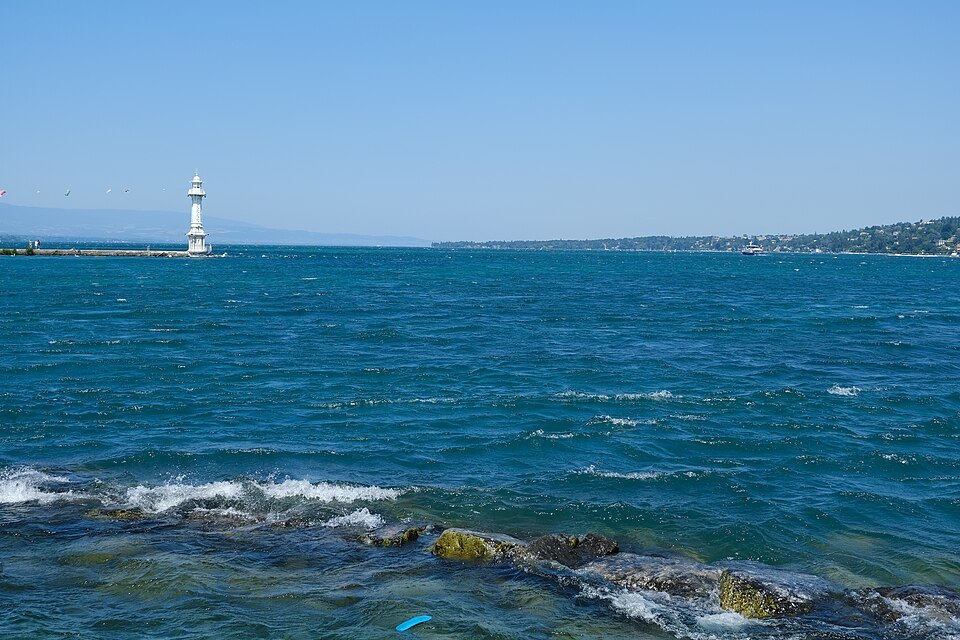
The choice was recognized formally again more recently: the site was listed as a geotope of national importance in 2012, acknowledging both its geological origin as a glacial erratic and its continuing role in the country's surveying system. Few other European capitals can point to a single visible stone in open water as the zero point for their national maps.
Who manages the lake today
The question the Pierre du Niton was first built to help answer, the level of the lake, is no longer settled by watching a graduated plate on a stone. It is now controlled by the Seujet dam, built in 1995 a short distance downstream on the Rhône, under an agreement signed in 1984 between Geneva and the cantons of Vaud and Valais. The dam regulates both the lake's level and the river's flow, generates electricity, and includes a fish ladder and a lock that allows the Rhône boats to pass through.
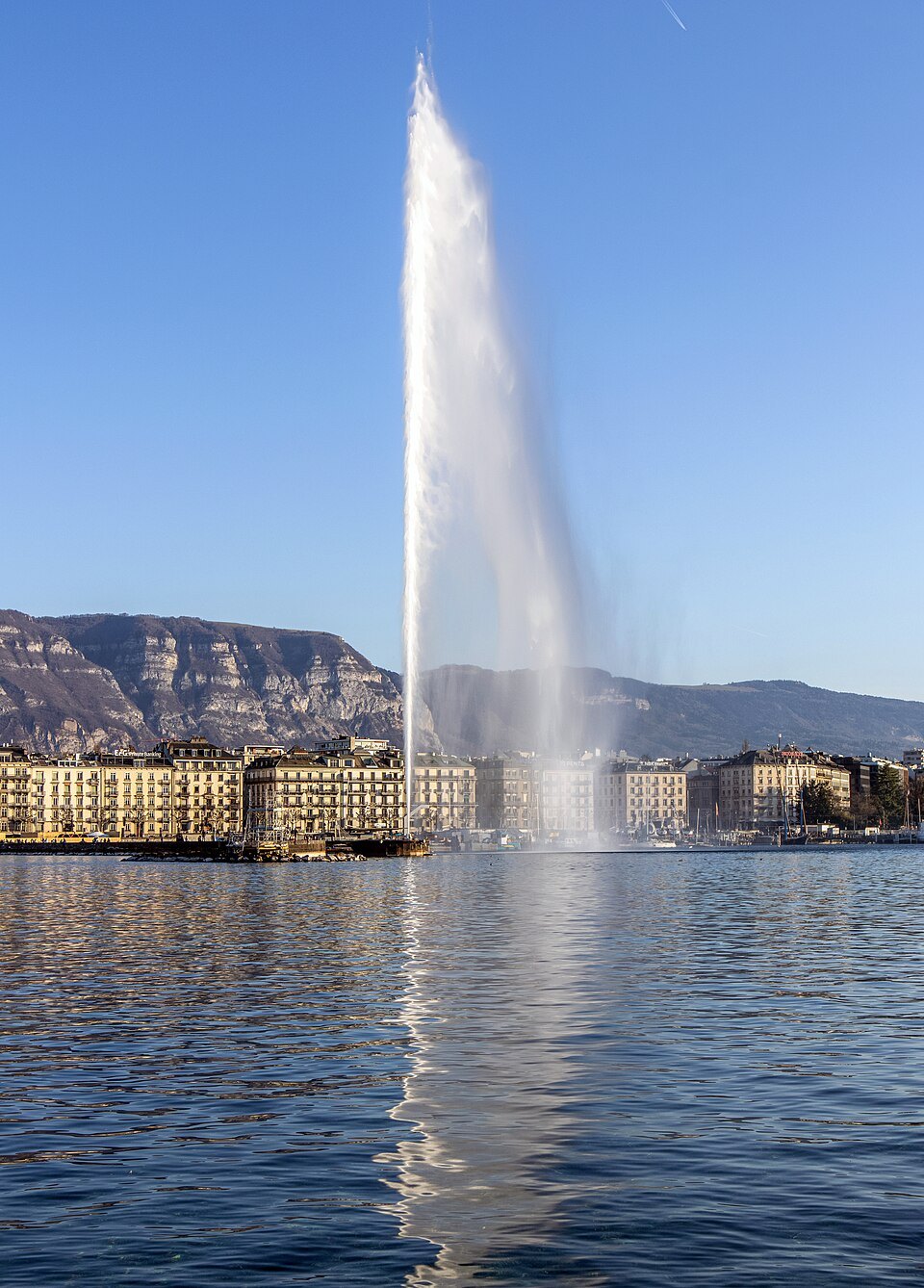
The Pierre du Niton remains the fixed altitude marker for the whole country, even though the practical, day-to-day work of managing the water now happens at the dam rather than at the stone itself. The two sit a short distance apart on the same stretch of river and lake, one a modern engineering structure, the other a boulder left by a retreating glacier, and together they tell the story of how a flood dispute in the nineteenth century grew into a national system of measurement.
Seeing the stones from the quay
The Pierres du Niton sit within view of the harbor walk along the left bank, best seen from the Quai Gustave-Ador or from the Jardin Anglais a little further along, with the Jet d'Eau often visible nearby at the tip of the Eaux-Vives jetty. They are not reachable on foot, and the usual way to see them closely is from the quayside paths or from one of the boats that cross or circle the harbor, including the small yellow Mouettes that run short lines between the two banks.
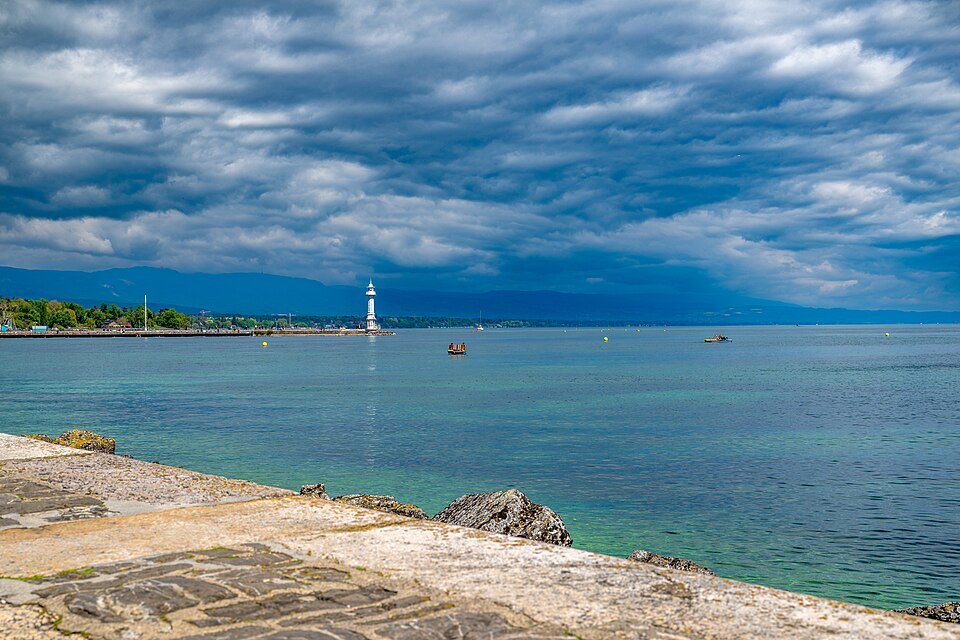
The stones carry no explanatory plaque beyond their quiet presence in the water, so visitors curious about current access, any markers on the boulders themselves, or further background should check with Geneva's tourism office. Anyone combining the stones with a longer look at the harbor and its boats might also plan a stop at the Bains des Pâquis on the opposite jetty, or time a visit around one of the lake cruises that depart nearby.
More from the journal
- The LakeCan you swim in Lake Geneva right in the city?Yes, and Genevans do, all year: the public baths on the Pâquis jetty, the new Eaux-Vives beach, the pools of Genève-Plage, how clean the water is, and what to know before you get in.Read the piece
- The LakeWhich lake cruise from Geneva is worth taking if you only have one afternoon?How to choose a short cruise from Geneva's two landings without losing the afternoon to travel time.Read the piece
- Getting AroundHow do the yellow Mouettes water buses work, and which crossing is best?What the yellow Mouettes water buses are, how the four lines differ, and which crossing suits a short visit.Read the piece