Home · Getting Around
One ticket, four ways to move
On foot
The center of Geneva is small. The lakefront, the bridges, the old town hill and the Pâquis all lie within a walk of one another, and much of the best of the city is seen from the quays and the lanes of the old town.
- Cornavin to the Pont du Mont-Blancabout ten minutes downhill
- The Pont des Bergues to the cathedralabout ten minutes, uphill through the old town
- The Jardin Anglais to the Jet d'Eaua short walk out along the Eaux-Vives jetty
The old town sits on a hill, and some of its lanes and passages are steep and stepped. Comfortable shoes matter more than distance.
Trams, trolleybuses and buses
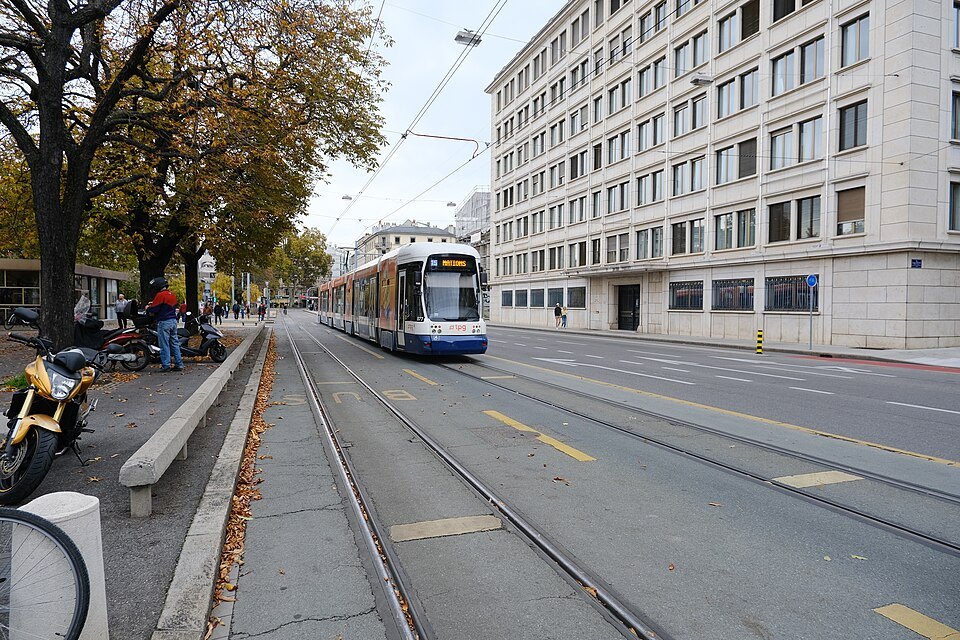
The TPG runs five tram lines, six trolleybus lines and dozens of bus lines across the canton and into neighboring France. Trams are the backbone: they link Cornavin with the Place des Nations, the center, Plainpalais and Carouge.
- Cornavin to the Place des Nationsabout eight or nine minutes by tram
- Cornavin to the Molard, by the lake on the left bankunder ten minutes
- Cornavin to Carougeabout a quarter of an hour
Buy a ticket before boarding, at the machine at the stop or in the TPG app, unless you hold a Geneva Transport Card.
The Mouettes
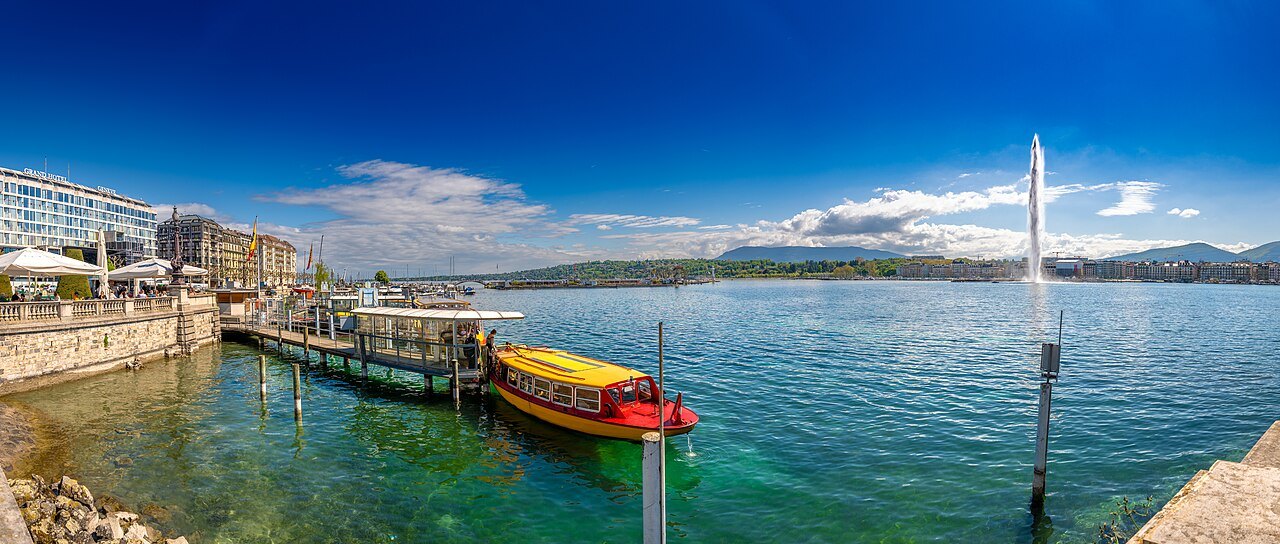
The Mouettes genevoises are four short water-bus lines, M1 to M4, across the harbor. They run all year, and the yellow boats are part of the ordinary public transport network, so a normal ticket or transport card covers them.
- M1 Pâquis to Molardthe shortest crossing, every ten minutes or so
- M2 Pâquis to the Quai Gustave-Adorunder a kilometer, every ten minutes or so
- M3 Pâquis to Genève-Plageabout every half hour
- M4 Genève-Plage to De-Chateaubriandabout every half hour
The Pâquis landing is the hub, a short walk from Cornavin along the quay. It is the quickest way across the harbor between the two banks.
Bikes
VéloPartage is the canton's official bike-sharing network, run through the Donkey Republic app with the Genèveroule association, which maintains the bikes. You find a bike in the app, unlock it from your phone and leave it at a drop-off point.
- Availabilitybikes seven days a week, around the clock
- Kindsordinary bikes, and electric bikes
- Agetwelve and over for ordinary bikes, fourteen for electric
The lakefront quays are flat and easy riding; the old town hill is steep, and its lanes are better walked.
Local trains
The Léman Express runs under the city between Cornavin and Eaux-Vives, with stations at Lancy-Pont-Rouge and Champel on the way. Inside the canton it takes the same tickets as the trams and buses.
- Cornavin to Champelabout twelve minutes
- Cornavin to Eaux-Vivesabout a quarter of an hour
- Cornavin to the airportabout seven minutes
Useful for the airport, for the left-bank lakefront around Eaux-Vives, and for the foot of the old town hill at Champel.
Getting Around Geneva by Tram, Boat and on Foot
The short version
Walk the center, take the tram for the Place des Nations and Carouge, and use the yellow water buses to cross the harbor. One ticket system covers all of it. If you are staying in registered accommodation, the free Geneva Transport Card covers it too, for your whole stay.
Geneva is a city of short distances. The lakefront, the old town, the Pâquis and the Plainpalais all lie within walking distance of one another, and the main reason to ride is the climb to the international quarter or the trip out to Carouge.
Tickets and the transport card
All public transport in the canton, including the TPG trams and buses, the local trains of the Swiss railways and the Mouettes water buses, shares the Unireso fare system. A ticket for zone 10, which covers the whole canton, can be used on any of them within its period of validity.
Single tickets are valid for sixty minutes, and there are day passes that run until early the next morning. They are sold at the machines at stops, in the TPG app, online at the TPG shop, and at agencies and resellers. Buy before you board and keep the ticket until you get off.
Anyone staying in approved accommodation registered with Geneva Tourism is entitled to the free Geneva Transport Card, a personal digital pass kept in the Hello Geneva app that covers buses, trams, trains and the Mouettes in zone 10 for the length of the stay. The Geneva City Pass, sold for twenty-four, forty-eight or seventy-two hours, adds the same transport to free or reduced entry at more than fifty activities.
The trams
Geneva was an early adopter of public transport. A horse-drawn service ran between the Place Neuve and Carouge from 13 September 1833, and by the end of the nineteenth century the city had a large tram network, powered by electricity, steam and, on some services, horses.
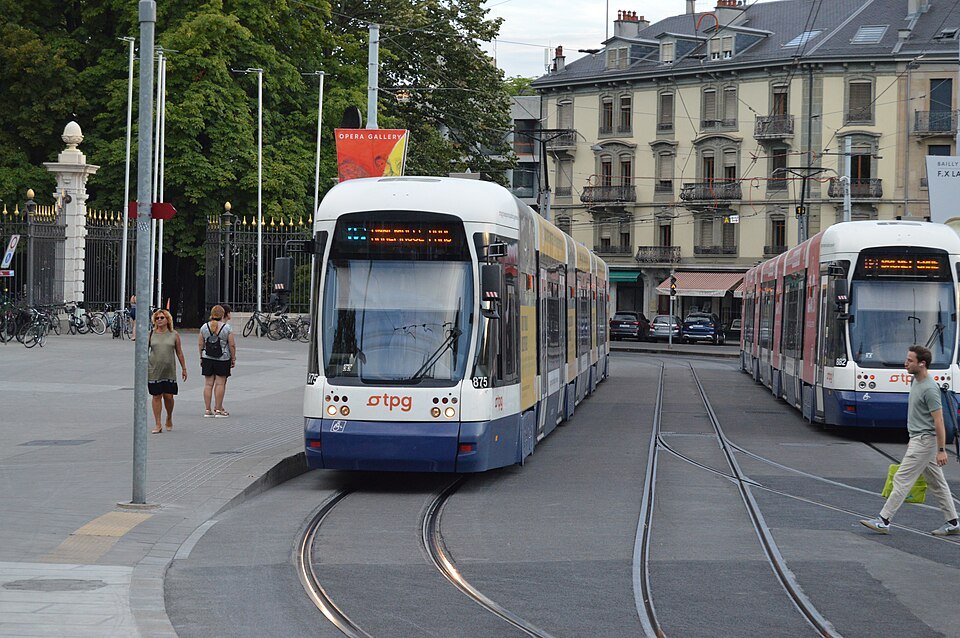
After the Second World War the trams were seen as an obstacle to cars and replaced by buses, until by 1969 a single line survived, from Carouge to Moillesulaz. After a popular vote in favor of public transport in 1988 the network grew again, and today five lines cover some fifty-six kilometers and about 135 stops.
For a visitor the most useful stops are Cornavin, in front of the main station; the Place des Nations, for the Palace of Nations, the Broken Chair and the Red Cross museum; the Molard, near the lake at the foot of the old town on the left bank; and Carouge.
Buses and trolleybuses
Trolleybuses run six lines through the city, and buses fill in the rest of the canton and cross into France. Among them are the double-articulated trolleybuses, about twenty-five meters long, that the TPG introduced in the mid-2000s.
Since December 2023, the night network works by extending ordinary daytime lines into the night, rather than running a separate set of night buses. Check the TPG app for the last departures on the line you need.
Buses are the way to reach the parks on the left bank beyond the Eaux-Vives and many of the smaller places in the canton, but in the center the tram and your feet are usually quicker.
Crossing the harbor
The Mouettes genevoises are a Geneva institution. Their ancestor was a service between the Pâquis and the Eaux-Vives started in 1825 by the businessman Edward Church, using a catamaran driven by paddle wheels turned by four horses walking in a circle on its deck. It was a failure and was sold at auction in 1828.
The present company was formed in 1897 by the merger of three rival operators, and the boats, once white, now carry the red and yellow colors of Geneva. Lines M1 and M2, both under a kilometer, run every ten minutes or so; M3 and M4, around a kilometer and a half, run every half hour. The service has run all year since 2004, and carried well over a million trips in 2016.
The fleet includes solar-electric boats of sixty places and older wooden boats. Being part of the Unireso network, the crossings take ordinary tickets. For longer trips on the lake, the large paddle steamers and motor ships are a separate service, covered on the Lake page.
Out to the edges
Two trips take most visitors beyond walking distance. The first is the international quarter. The tram from Cornavin reaches the Place des Nations in about eight or nine minutes, and from there the Broken Chair, the gates of the Palace of Nations, the Musée Ariana and the Red Cross and Red Crescent Museum are all a short walk, the museum a little uphill.
The botanical garden lies below, toward the lake. Walk down from the Place des Nations, or come along the shore on foot from the Pâquis; the M4 water bus calls at De-Chateaubriand, near the lakeside parks.
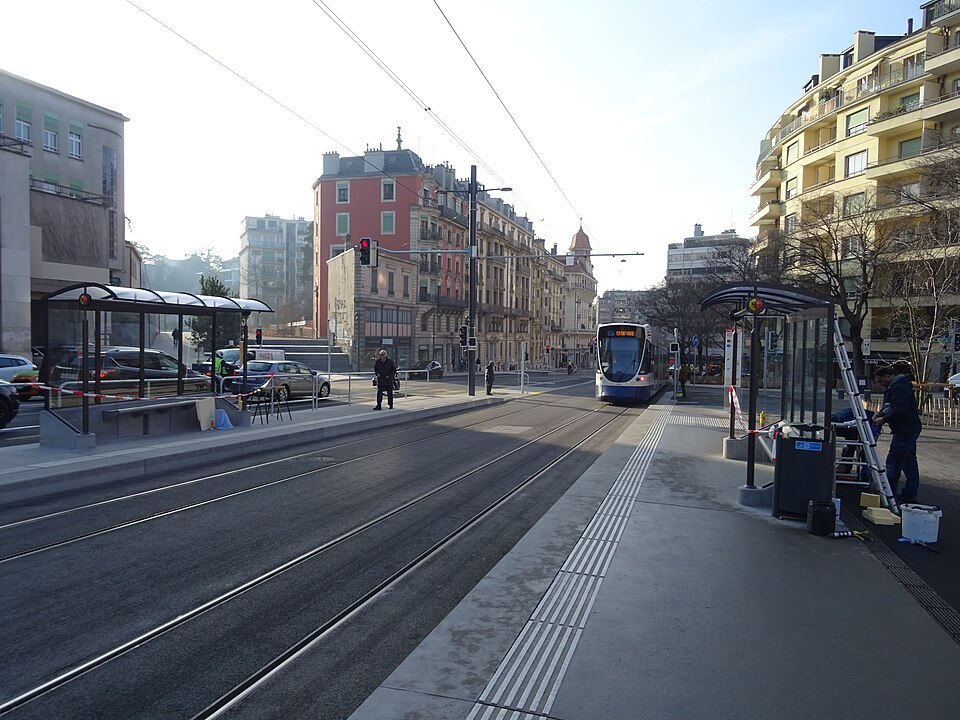
The second is Carouge, the old Sardinian town across the Arve, about a quarter of an hour from Cornavin by tram. It was the destination of Geneva's very first public transport service, the horse-drawn carriage from the Place Neuve in 1833.
Bikes
Geneva's official bike-sharing network is VéloPartage, operated by Donkey Republic in partnership with the Genèveroule association, the canton and the municipalities. Download the Donkey Republic app, create an account, find a bike on the map, unlock it from your phone and end the rental at one of the drop-off points.
Bikes are available every day, around the clock, and the fleet includes electric bikes. Riders must be at least twelve for an ordinary bike and fourteen for an electric one. The flat quays along both banks are the pleasantest riding in the city; the old town is steep, and better on foot.
Walking the city
The easiest walk in Geneva follows the water: from Cornavin down to the Quai du Mont-Blanc, across the Pont des Bergues past Île Rousseau, and along the left bank through the Jardin Anglais to the Eaux-Vives jetty and the Jet d'Eau.
The old town is a separate climb. From the Molard or the Place du Bourg-de-Four side, lanes and passages lead up to the cathedral, the town hall and the Promenade de la Treille, and down the other side to the Parc des Bastions and the Place Neuve.
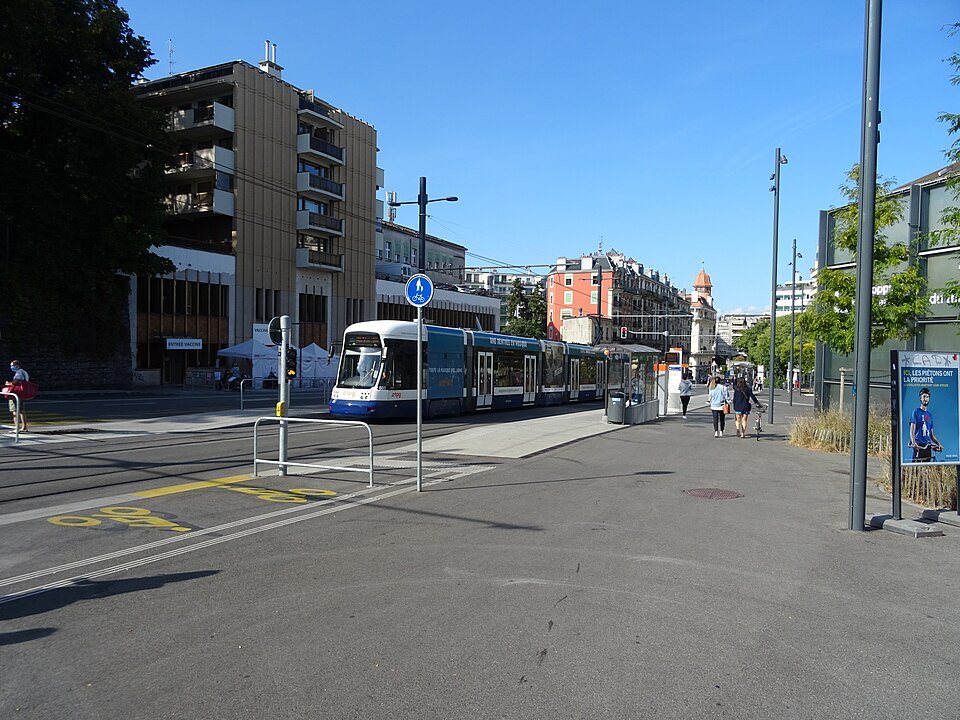
The walk drawn on the home page strings the main sights together in one route. Plan it in two halves if you want time inside the museums.
Services we link to
Some links on this page are affiliate links. If you book through one we may earn a commission, at no extra cost to you. It does not affect what is recommended here, and no sight page on this site carries one.
Between a morning arrival and an afternoon check-in:
More photographs
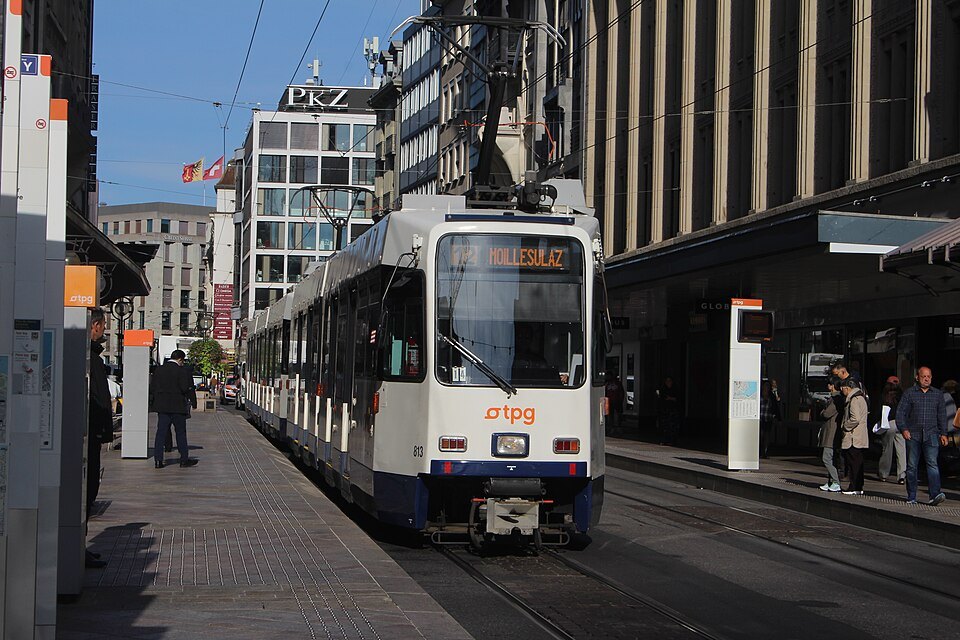
An older tram on line 12 at a city stopAubrey, Wikimedia Commons, CC BY 2.0 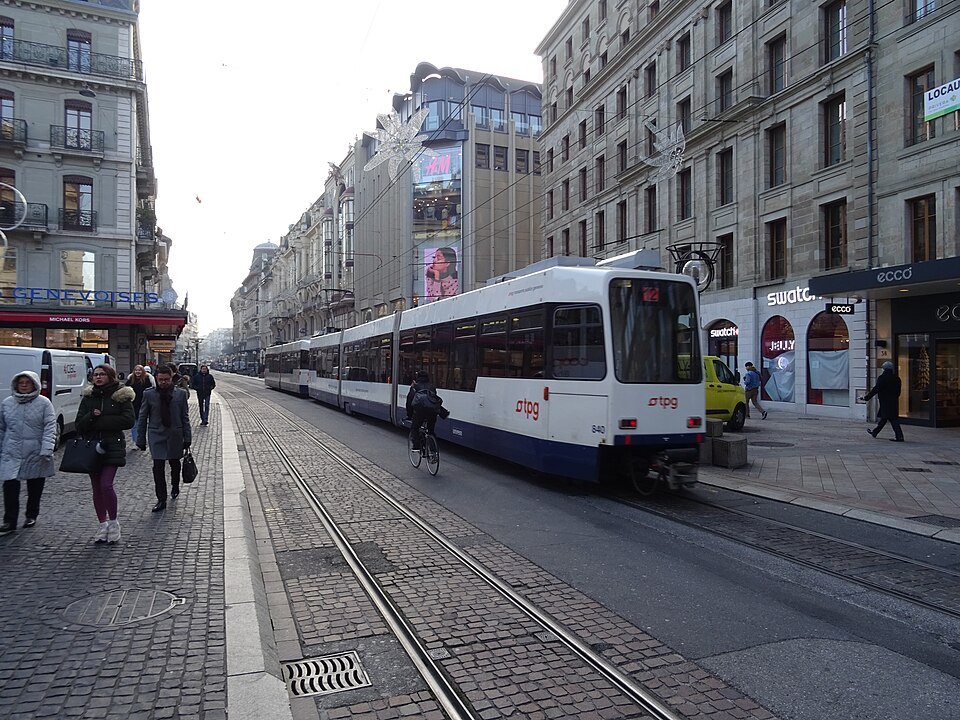
A tram running along a busy shopping street past pedestriansRemontees, Wikimedia Commons, CC BY-SA 4.0