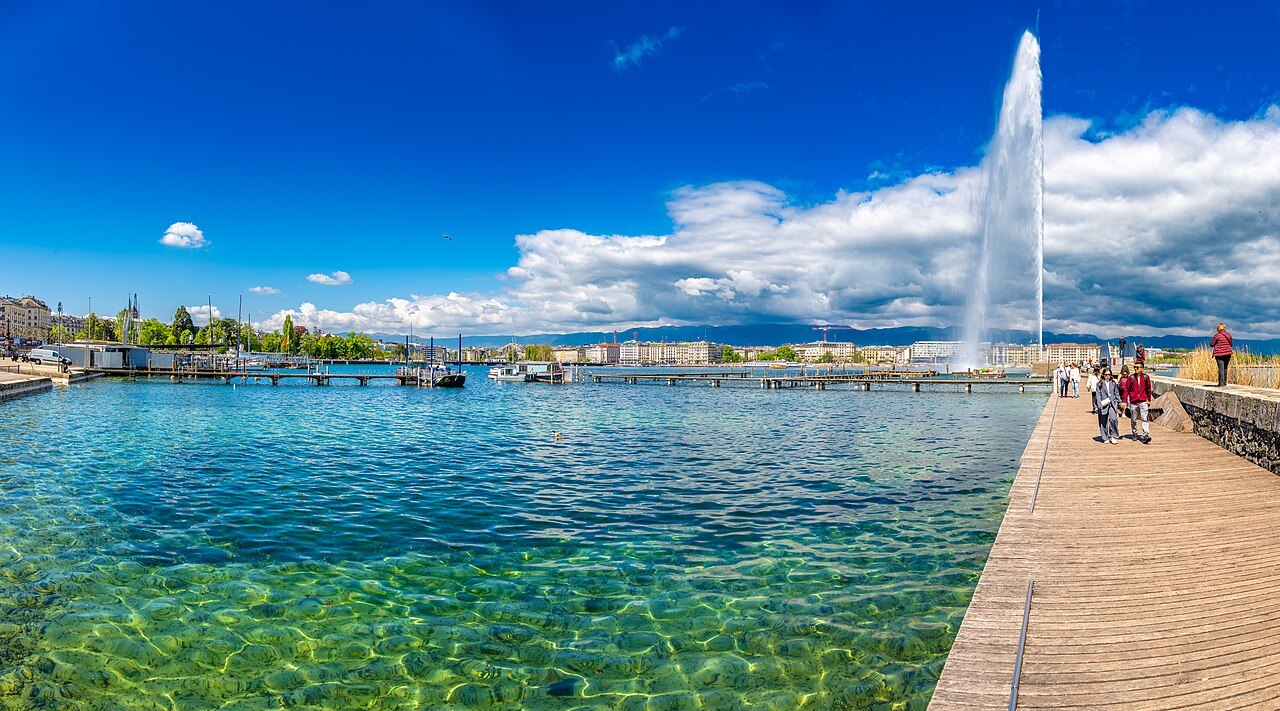
The Jet d'Eau
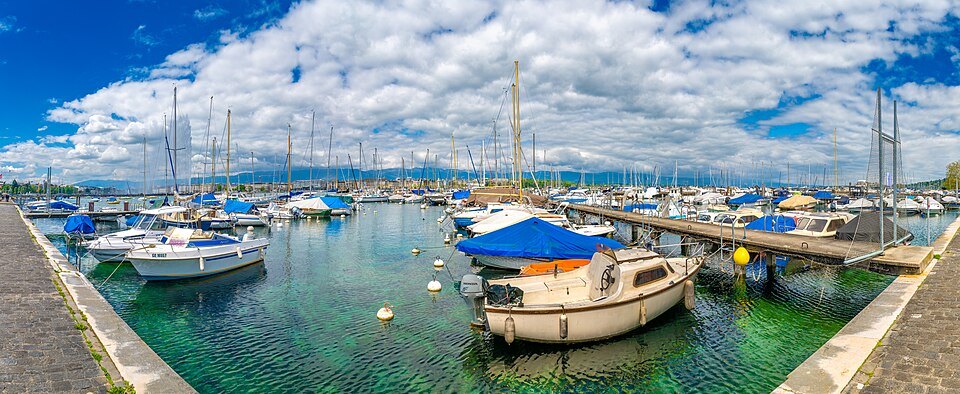
- IThe plumeA white column of lake water about 140 meters high, whitened by air forced into the jet
- IIThe nozzleA single nozzle at water level, where the jet leaves at about 200 kilometers an hour
- IIIThe stone jettyThe Jetée des Eaux-Vives, a walkway out into the harbor that passes right beside the fountain
- IVThe little lighthouseA small light at the far end of the jetty, the partner of the one on the Pâquis side
- VThe pumping stationA partly submerged plant beneath the jetty, drawing lake water rather than city water
- VIThe drift of sprayWhatever the wind decides: on some days the plume leans out over the lake, on others over the walkway
From darkness to light
Why it matters
Geneva has older monuments and grander ones, but no other single object stands for the city the way this fountain does. It rises from the left side of the harbor, where Lake Geneva narrows and turns into the Rhône, and it can be seen from the quays, from the old town, from the hills around the city and, on a clear day, from aircraft flying high over it.
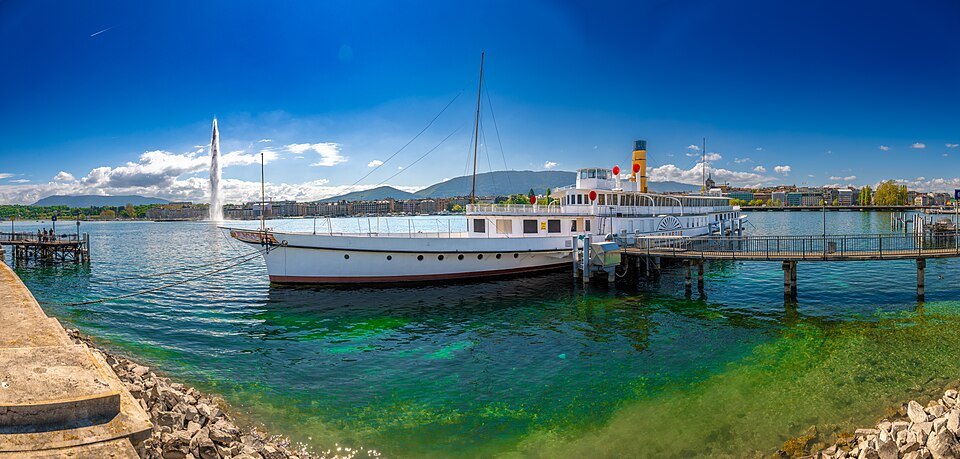
The numbers explain some of that. About five hundred liters of water leave the nozzle every second at roughly two hundred kilometers an hour, and at any moment several tonnes of water are in the air. French sources give the height as 140 meters; some English sources round it up to 150. Either way it is far taller than the cathedral towers on the hill behind it.
It also explains something about Geneva itself. A plain piece of engineering, a pressure valve, became the city's emblem almost by accident, and the city then took the trouble to move it, rebuild it and keep it running for well over a century. Few landmarks are this practical in origin and this decorative in result.
From a safety valve to an emblem
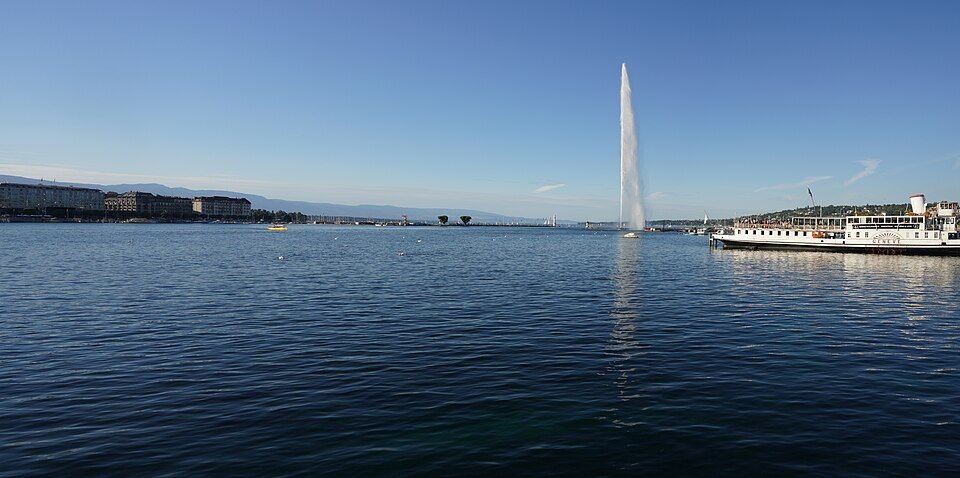
The first jet was not meant to be seen. In 1886 the city opened a hydraulic plant at the Coulouvrenière, downstream on the Rhône, to deliver water power to the workshops of a growing town. In the evening, when the workshops shut down their machines, pressure built up in the network, and the engineers fitted a safety valve that simply let the excess water escape into the air. That first jet rose about thirty meters.
People liked looking at it. In 1891, for the six hundredth anniversary of the Swiss Confederation and the federal gymnastics festival held in the city, Geneva moved the fountain to the end of the Eaux-Vives jetty in the middle of the harbor. The new jet reached about ninety meters and was lit at night from a raft moored in the harbor; for a while it ran only on Sundays.
The fountain you see dates from 1951. Plans drawn up after the war gave it its own pumping station, partly under water and drawing from the lake instead of the drinking-water network, and the first test run took place in April of that year. That independence is what lets it run far more often, and what pushed it to its present height.
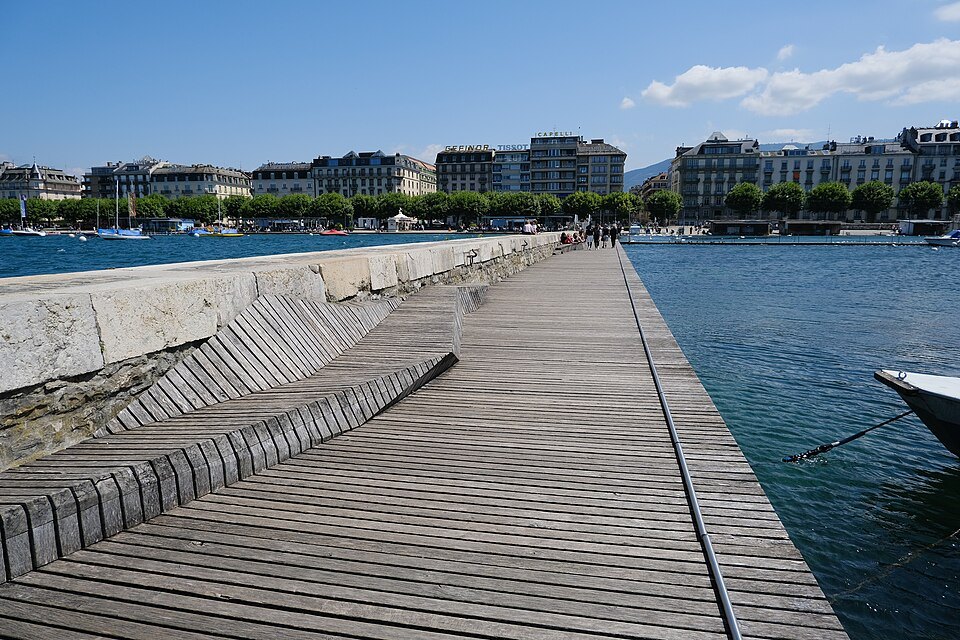
The fountain belongs to SIG, the city's utility company, which maintains it and occasionally changes it. It has been lit in national colors after events abroad, switched off during the lockdown of spring 2020, and fitted in 2025 with a new nozzle designed to vary the flow and save energy.
What you actually see
From a distance, a white feather of water standing out of the lake, leaning with the wind. The whiteness is deliberate: the nozzle mixes air into the water, which turns a clear jet into the opaque plume that photographs so well against a blue sky or a dark storm cloud.
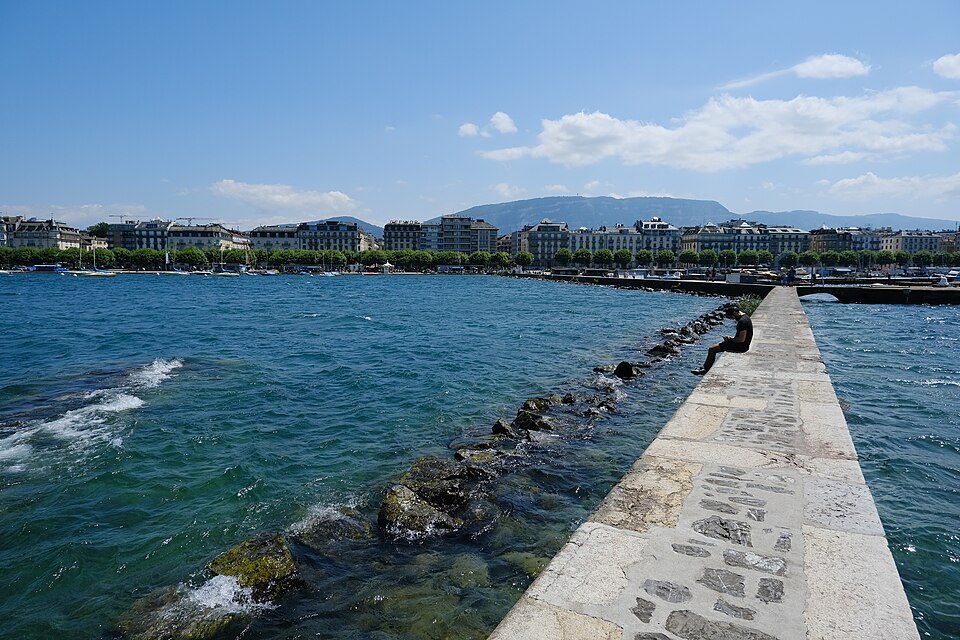
Close up, it is a different experience. The Jetée des Eaux-Vives is a stone walkway that runs out from the Quai Gustave-Ador on the left bank, and you can walk along it to within a few meters of the base. The noise is a steady roar, the ground is wet for a long stretch, and the water falls back around the jet in a ring of white foam.
At the far end of the jetty stands a small lighthouse, one of a pair that marks the harbor entrance; its twin is on the Pâquis jetty across the water. From the end of the walkway you look back at the whole city front: the quays, the hotels along the right bank, the old town on its hill and the cathedral above it.
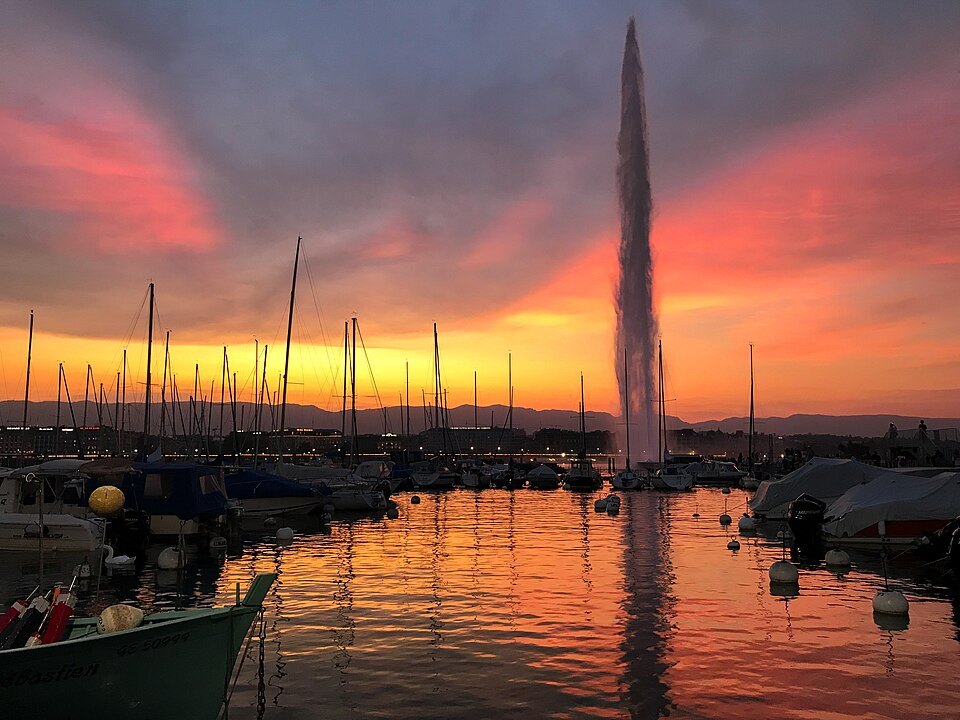
On a clear day the Salève, the long limestone ridge just across the border in France, fills the background to the south, and the plume stands in front of it. On an evening from spring to autumn, when the fountain is lit, it glows against the dark lake.
How to visit
There is nothing to book and nothing to pay; the jetty is a public walkway. Give it half an hour if you walk out to the lighthouse and back, and longer if you want to watch it from several sides. It fits naturally into a walk along the left-bank shore from the Jardin Anglais toward Parc La Grange.
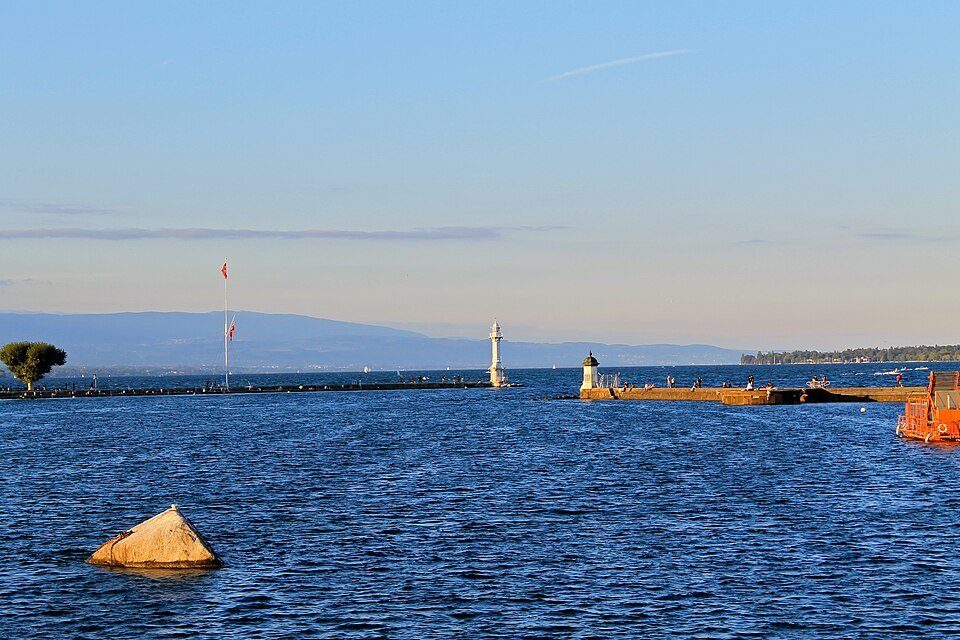
Read the wind before you walk out. With the breeze blowing across the jetty, the spray drenches the walkway, and plenty of visitors have walked back soaked. The safest approach on a windy day is to watch from the quay first and see which way the plume is leaning.
The fountain is stopped in frost and in strong wind, and it has a maintenance stop each year, so a winter visitor may find only the jetty. The operator's site and the city's webcam are the places to check on the day.
The best views are often from somewhere else: from the Pâquis jetty and the Bains des Pâquis on the opposite shore, from the Pont du Mont-Blanc, from the yellow water buses that cross the harbor, and from the top of the cathedral towers, where the plume stands above the roofs of the old town.
Honest notes
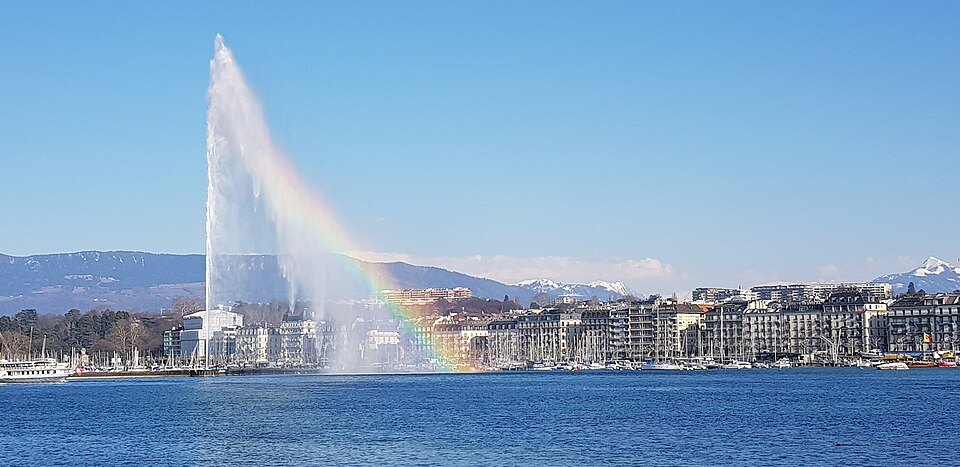
It is not the tallest fountain in the world, and it has not been for a long time; fountains built since, from Jeddah to Seoul, throw water far higher. What makes this one remarkable is its setting in the middle of a working city harbor, and its age.
The height quoted varies from source to source because the plume is not a fixed object: wind, flow and the new adjustable nozzle all change it. The figure of about 140 meters is the one used locally.
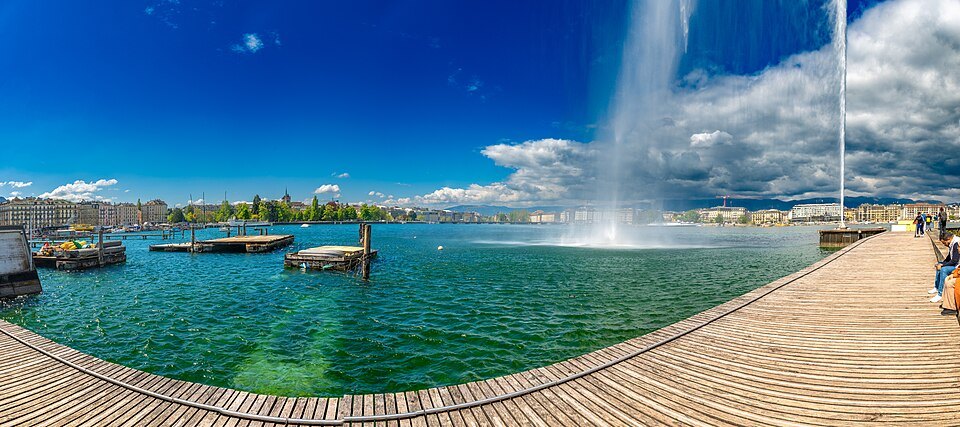
Being close is not the same as seeing it well. The jet is best understood from a few hundred meters away, where you can see how far it rises above everything around it.
Nearby
- A few steps awayThe Jardin Anglais and the Flower ClockGeneva's first English-style park, created in the 1850s on land won from the lake, with the flower clock of 1955, the National Monument, a cast-iron fountain and the harbor's two glacial boulders offshore.Read the page
- A few steps awayParc La Grange and Its Rose GardenTwenty hectares of old trees and lawns sloping to the lake on the left bank, with the canton's largest public rose garden, an eighteenth-century villa and its library, Roman remains underfoot, and the Parc des Eaux-Vives next door.Read the page
- A few steps awayThe Bains des PâquisPublic lake baths of 1932 on the right-bank jetty, saved by a popular vote in 1988 and run by their users ever since: swimming in summer, sauna and fondue in winter, and the Jet d'Eau across the water all year.Read the page