Home · Sights · Île Rousseau and the Pont de la Machine
Île Rousseau and the Pont de la Machine
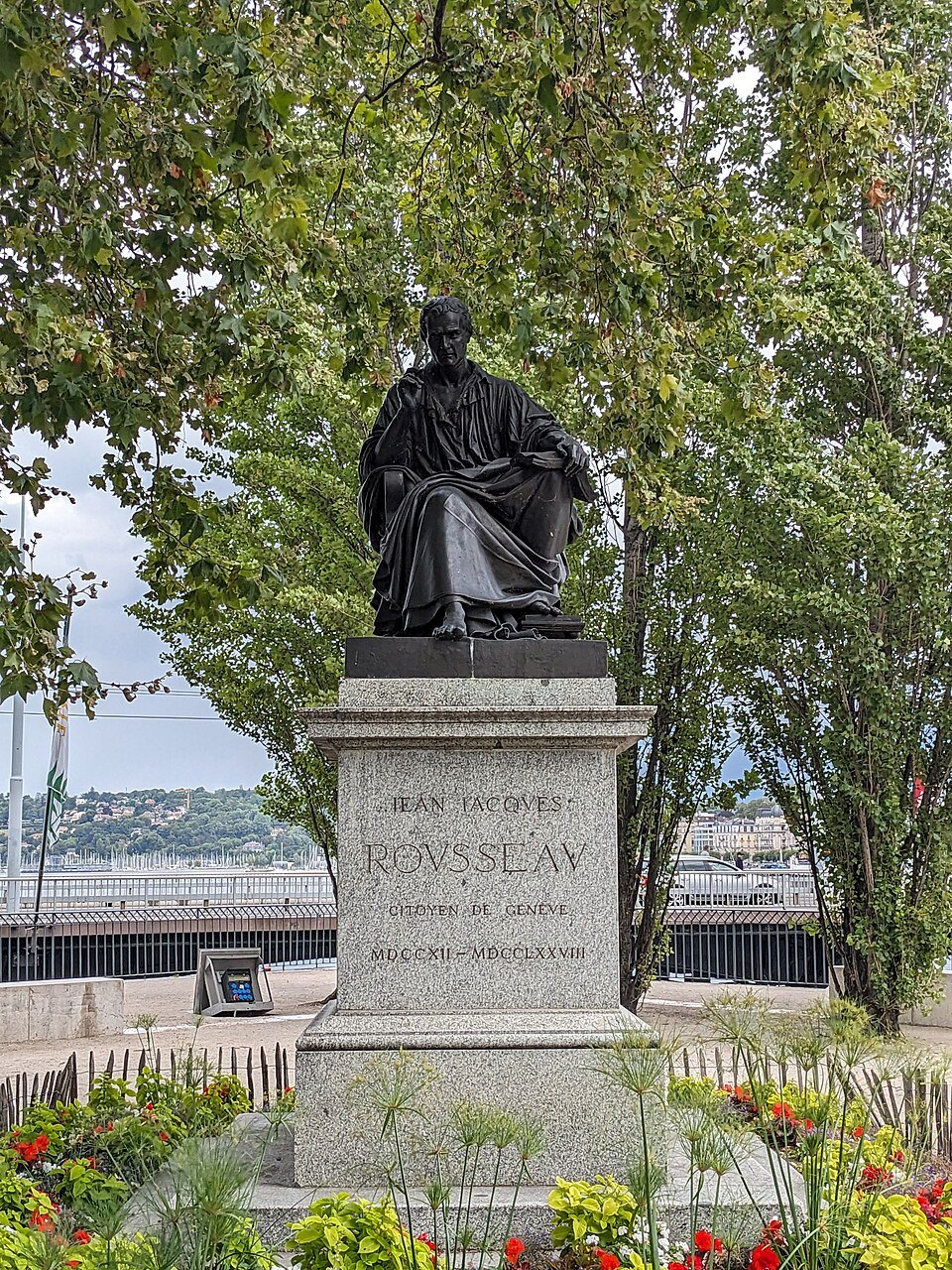
- IRousseau's statueJames Pradier's bronze of the philosopher, inaugurated in 1835 and turned back to face the city in 2012
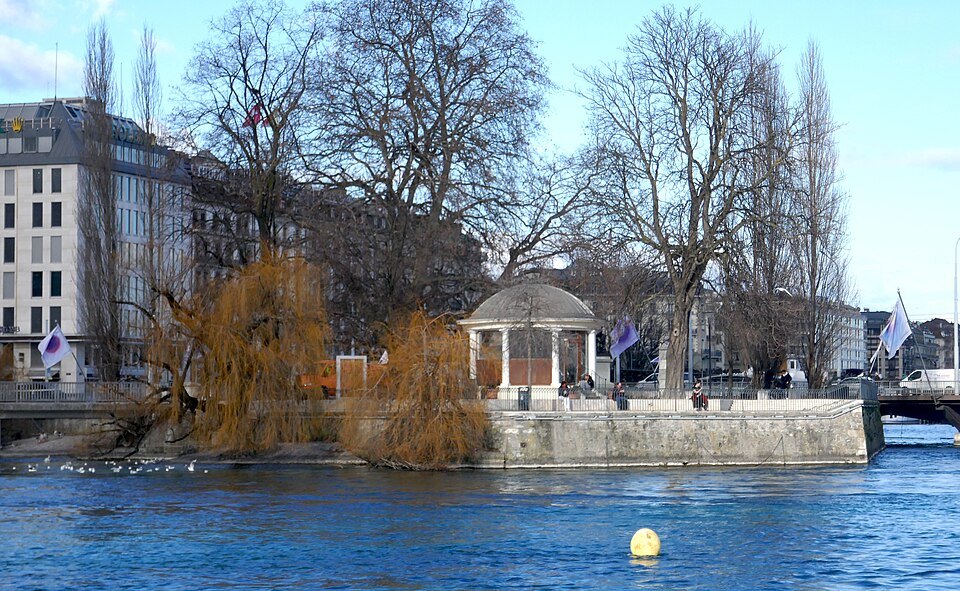
- IIThe island bastionA fortification of 1585–1588 at the lake entrance, later a shipyard for the government's boats
- IIIThe Pont des BerguesA bridge first built by Dufour in 1834, with a footbridge branching off to the island
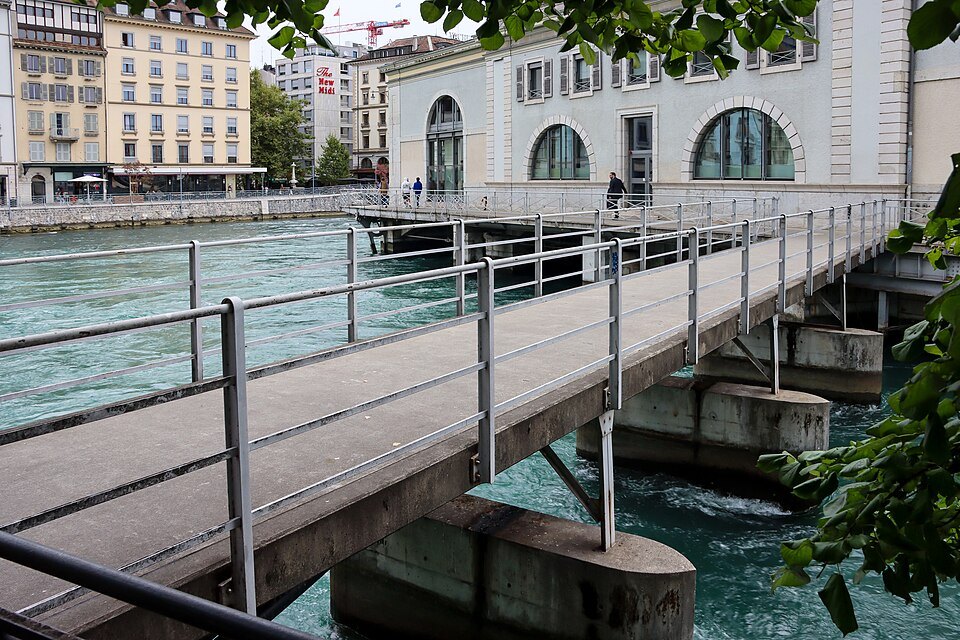
- IVThe Pont de la MachineA riveted iron footbridge of 1884–1887, the oldest engineering work in the city
- VThe machine buildingThe river pumping station of 1843, later Geneva's first power plant, now an exhibition space
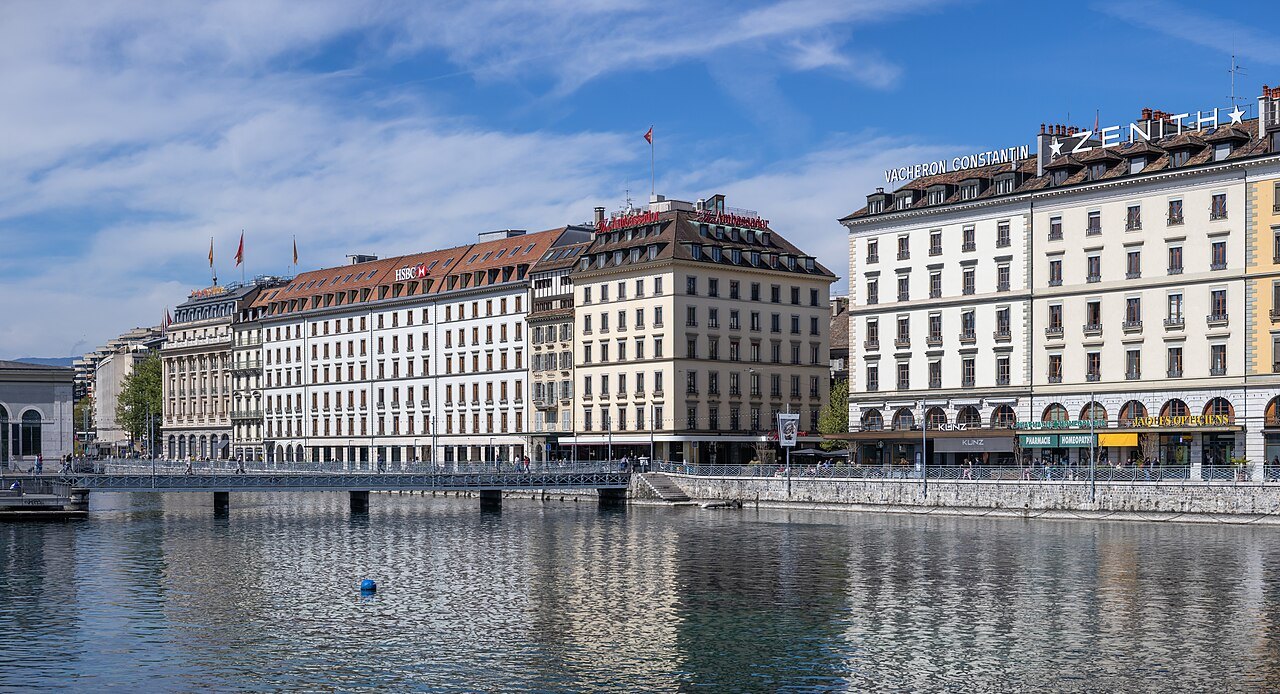
- VIThe clear currentThe Rhône running fast and blue-green out of the lake between the two banks
From darkness to light
Why it matters
Lake Geneva ends in the heart of the city. Just below the Pont du Mont-Blanc the lake narrows into the Rhône, and within a few hundred meters the water is already running fast between the two banks of Geneva. This short stretch, with its island, its bridges and its old water machine, is where you can see most clearly how the city grew up around the point where a great lake becomes a river.
It is also a place with a long story. The island was a fortress before it was a garden, the bridges were built and rebuilt by the city's engineers, and the building in the middle of the Pont de la Machine once pumped the water for the city's fountains and then made Geneva's first electricity.
For a visitor it is simply one of the most pleasant places in the center: a garden island in the current, with a view up the harbor to the Jet d'Eau and down the river toward the old town.
The island
The island was originally called the Île aux Barques, the island of boats. Between 1585 and 1588 the city built a bastion here under the direction of the mason-architect Nicolas Bogueret to strengthen the lakeside entrance to Geneva. From 1587 it was used to build and repair the government's boats; later it held a powder mill and, from 1617, a quarantine store for goods coming from regions struck by infectious disease.
Everything changed with the building of the Pont des Bergues. In 1834 a footbridge linked the island to the new bridge, poplars were planted, and between 1834 and 1836 the old bastion was laid out as a public promenade. It took its present name in honor of Jean-Jacques Rousseau, born in Geneva in 1712.
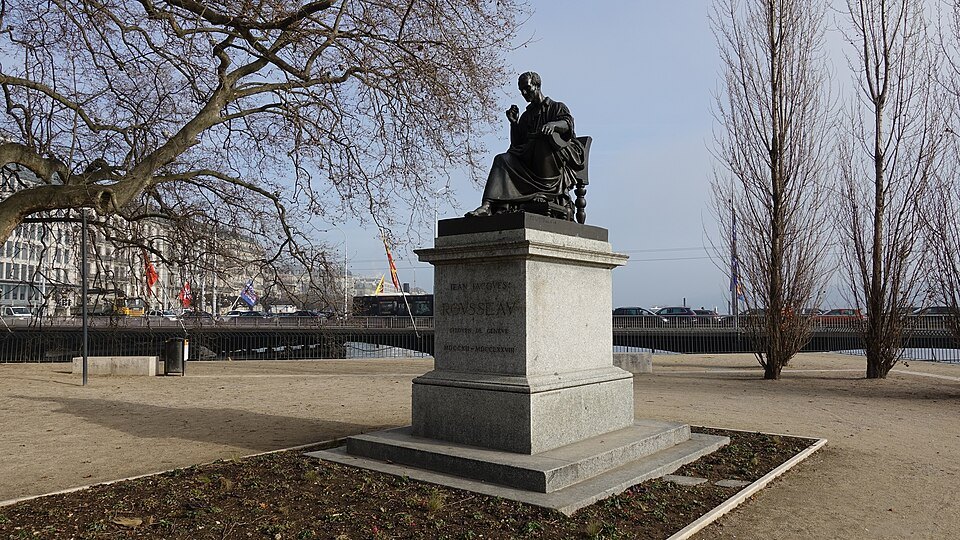
In 1830 the sculptor James Pradier was commissioned to make a bronze statue of the writer, and it was inaugurated on the island in 1835. For the tricentenary of Rousseau's birth in 2012 the city restored the island: the statue was cleaned and returned to its original orientation, looking toward the city rather than the lake, new poplars replaced diseased trees, a stone bench-wall about seventy meters long was built, and the pavilion was given back its original outline.
The bridges
Three bridges cross the Rhône in quick succession as it leaves the lake. The first is the broad Pont du Mont-Blanc, first built in 1862 and lined with flagpoles. The second is the Pont des Bergues. Its first version, a chain suspension bridge designed by the cantonal engineer Guillaume-Henri Dufour, took two spans with a round terrace in the middle of the river, from which the footbridge ran to the island.
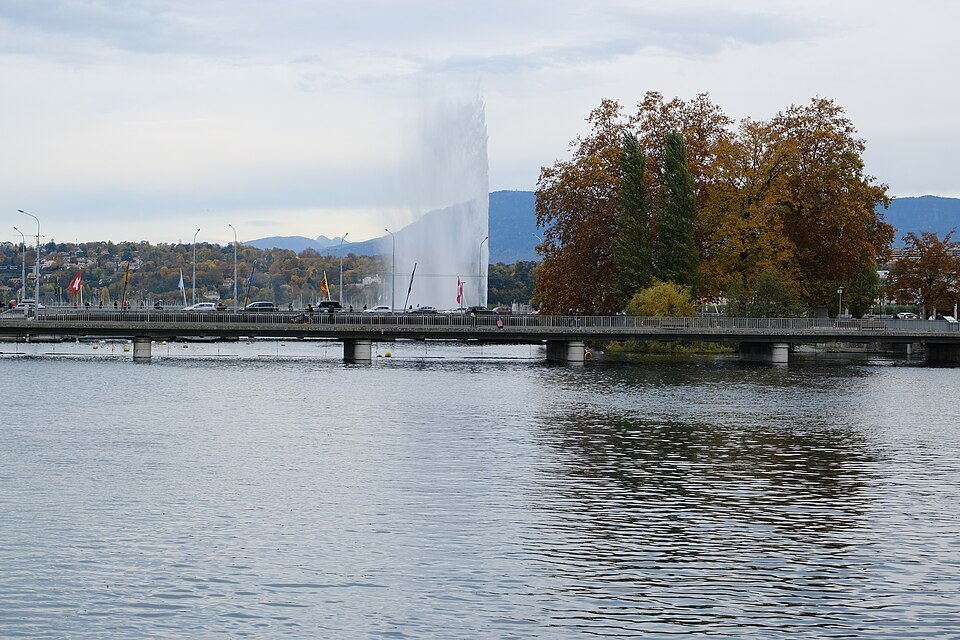
That first bridge collapsed during testing at the end of 1833 because of poor-quality chains, and it opened after repairs in May 1834. It was replaced in 1881 by the girder bridge that still stands, and it has been reserved for pedestrians and cyclists since 1982.
The third is the Pont de la Machine. In 1709 a hydraulic machine was built at the entrance of the left arm of the Rhône to pump river water to the city's fountains, and the dam and walkways that grew up around it gave the bridge its name. A new machine of 1841 stood in the middle of the river, and a footbridge crossing the whole riverbed opened in 1844.
What you actually see
On the island, the statue of Rousseau sits in the middle of a gravel promenade shaded by poplars, with benches along the stone wall and the small pavilion at the upstream end. The water on either side is strikingly clear, and birds are kept in enclosures on the island.
The Pont de la Machine is a footbridge of riveted puddled iron on a wooden deck, built in two sections in 1884 and 1887 when the river was divided into two channels. It is the only one of the city's bridges never to have been rebuilt, which makes it the oldest engineering work in Geneva. When it was renovated between 2007 and 2009, the original look was kept, down to rivets set hot by hand.
Halfway across stands the machine building. The pumping station was converted in 1886 into Geneva's first electricity plant, supplying power for street lighting until about 1898. The dam it carried was dismantled in 1995, when the Seujet dam downstream took over the regulation of the lake, and the building now holds a city information point and an exhibition space of the utility company SIG.
The dam of the Machine had a long political history: by raising the level of the lake it caused damage along the shores of the canton of Vaud, and the quarrel between the two cantons went to the Federal Court before a convention settled it in 1884.
How to visit
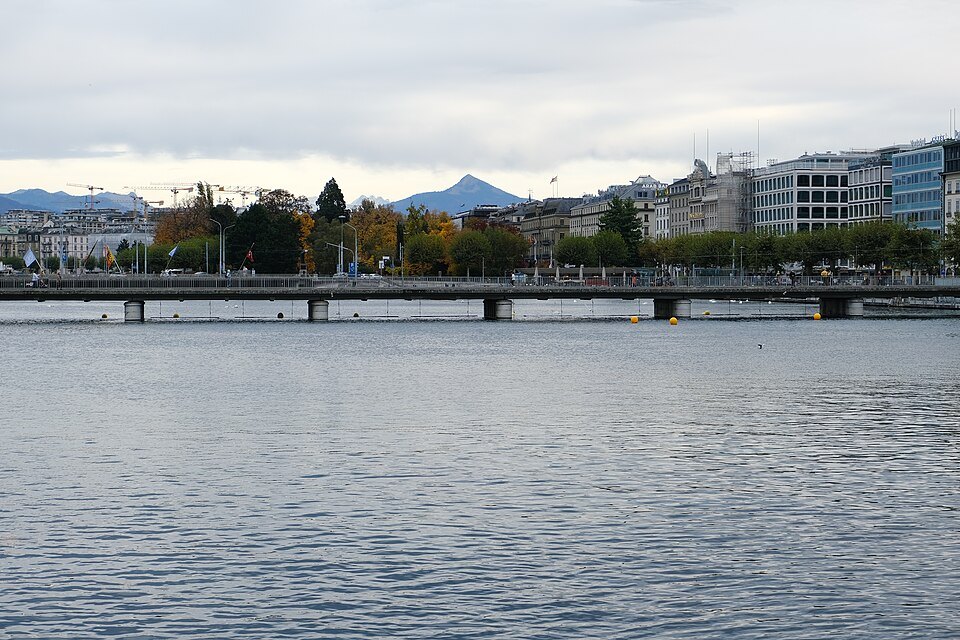
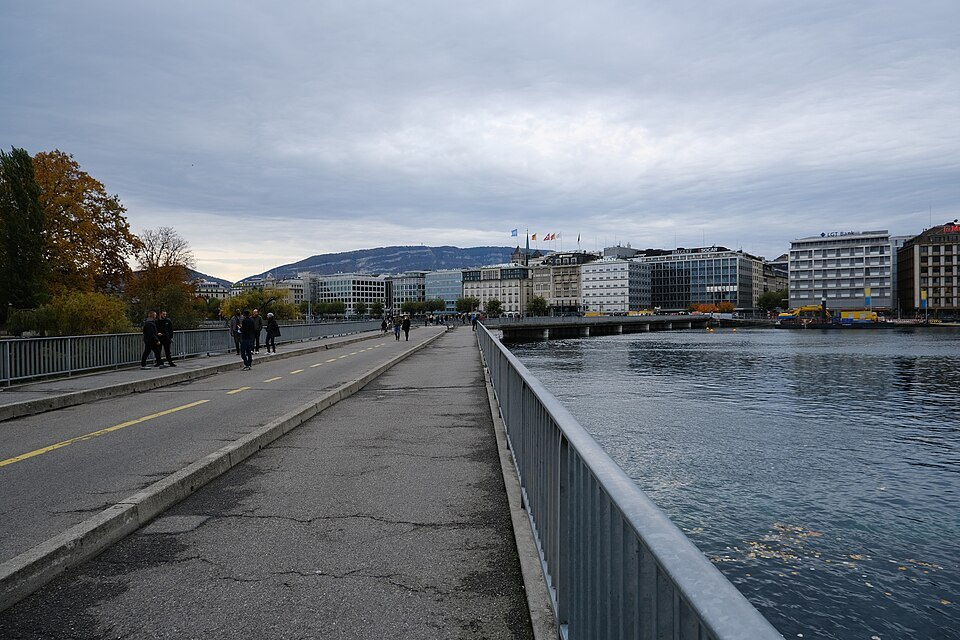
Everything here is public and free to walk. Half an hour covers the island, the Pont des Bergues and the Pont de la Machine; linger longer on the island benches. The island is reached by the footbridge from the middle of the Pont des Bergues.
It sits between the Jardin Anglais on the left bank and the Quai du Mont-Blanc on the right, so it joins naturally with both, and the old town is a short climb from the left end of the Pont de la Machine.
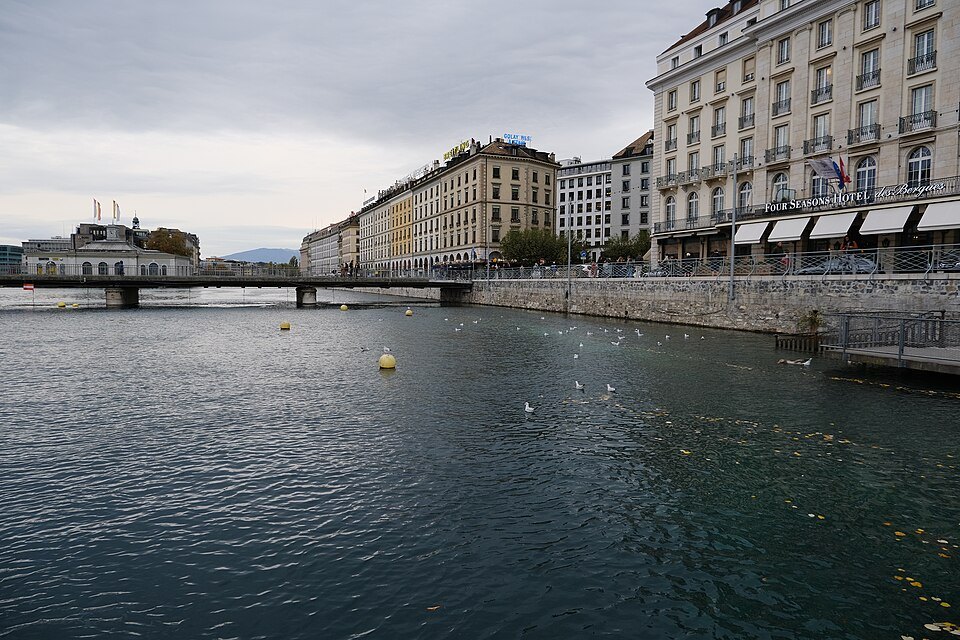
For the best view of how the lake turns into a river, stand on the Pont des Bergues looking upstream toward the Pont du Mont-Blanc and the Jet d'Eau beyond it, and then turn around to watch the current race away under the Pont de la Machine.
Nearby
- A few steps awayThe Jardin Anglais and the Flower ClockGeneva's first English-style park, created in the 1850s on land won from the lake, with the flower clock of 1955, the National Monument, a cast-iron fountain and the harbor's two glacial boulders offshore.Read the page
- A few steps awayThe Quai du Mont-Blanc and the Brunswick MonumentThe right-bank lakefront of the grand hotels, from the Pont du Mont-Blanc to the Pâquis jetty, with a Duke of Brunswick's extravagant Gothic tomb, the spot where Empress Elisabeth was stabbed, and a view to Mont Blanc on clear days.Read the page
- A few steps awayThe Jonction, Where the Rhône Meets the ArveAt the western tip of the Jonction district, the clear turquoise Rhône from the lake meets the gray, silt-laden Arve from the glaciers of Mont Blanc, and for a long stretch the two refuse to mix.Read the page